
Buying a Farmhouse in the Marche as a Foreigner: What You Really Need to Check Before Purchasing

You've found the farmhouse of your dreams in the Marche.
Exposed stone, rolling hills around you, maybe a sea view or a small village just a short drive away. The price seems attractive, especially compared to similar properties in Tuscany.
Before signing, though, it's worth understanding exactly what you're buying.
Not to alarm you.
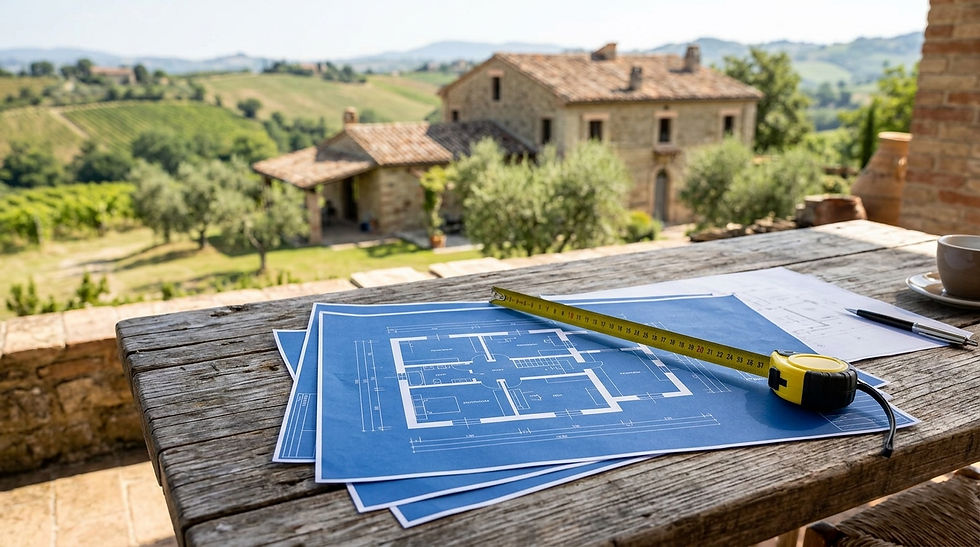
To give you the right information so you can decide with peace of mind.
And this distinction, in my view, is essential.
Checking Doesn't Mean Hunting for Problems at Any Cost
When a client asks me to check a farmhouse before purchase, my job isn't to find as many irregularities as possible.
My job is to understand which problems are real, what consequences they actually have, and which ones have no real impact on the property or the project.
It sounds like a subtle difference. It isn't.
Because there's another way of doing this job: looking for any possible loophole, turning every minor irregularity into a problem, and then offering a procedure to "fix everything."
Some professionals, unfortunately, work exactly this way.
You'll come across some who turn every irregularity, even the most insignificant one, into a business opportunity.
And let's say it plainly: some operators on the market use scare tactics with clients because scare tactics generate work.
They find an irregularity, present it as a major obstacle, suggest a formal regularization process, and are, of course, ready to handle the paperwork themselves.
Sometimes it's genuinely necessary.
Often it isn't.
And when it isn't, turning a technical inspection into a machine for generating paperwork and fees is not, in my opinion, doing this job well.

Planning and Cadastral Compliance: What to Actually Look At
The first check is comparing the property's actual condition with the available planning and building documentation.
In rural farmhouses, it's normal to find buildings that have gone through decades of changes: an enclosed veranda, a canopy, an added bathroom, a different internal layout, a modified window.
This doesn't automatically mean there's a problem to solve.
Any irregularity needs to be assessed in context: when it was made, what it involves, how significant it is, and above all whether it has any real impact on the property's current status or on the work you intend to carry out.
Cadastral records also need checking, but without confusing the land registry with building compliance — they're two different things, and a correct cadastral plan alone doesn't prove building compliance.
The goal isn't to find a loophole.
It's to understand what you're really buying.
Amnesties and Regularizations: Not Everything Needs a New Procedure
Many farmhouses have a long building history.
Work carried out decades ago may have gone through a building amnesty or subsequent regularization procedures.
A proper check reconstructs this history and establishes whether those procedures were actually completed, and what the property's current status is.
But there's a misunderstanding to avoid here too.
The presence of an old irregularity doesn't automatically mean a new regularization is needed.
And it certainly doesn't mean a professional should invent a problem in order to propose paperwork.
It sounds obvious. It isn't always.
I've seen situations where a minor irregularity, with no real impact on the property or the planned work, was turned into a lengthy debate about the need to "regularize everything."
And when the municipal technical office itself was asked about it, it often didn't consider that regularization necessary at all.
At that point, the question should be: who actually benefits from that paperwork?
Landscape Constraints and Agricultural Zoning
Many farmhouses in the Marche sit in agricultural land and may be subject to landscape protections or other constraints.
No scare tactics here either.
A constraint doesn't automatically mean you can't renovate.
It means you need to understand the rules that apply to that specific property and how they'll shape your project.
Large window openings, roof changes, extensions, a swimming pool, outdoor layouts, materials and finishes can all be subject to different conditions and procedures.
This is exactly why it's important to check the situation before purchasing, especially if you already have a clear vision for transforming the farmhouse.
Water, Electricity and Drainage
Then there are the less photogenic aspects of the listing photos — but far more important in everyday life.
How does water reach the property?
What's the available electrical capacity?
How is wastewater disposed of?
In isolated farmhouses not connected to the municipal sewage system, you need to check what treatment and disposal system is in place, and whether it's properly authorized.
This isn't necessarily a problem.
It's simply something you need to know.
A good professional should tell you what's there, what works, what might need upgrading, and how much that could affect the project.
They shouldn't make you believe that anything different from city living is an emergency.
Access and Rights of Way
Access also deserves a check.
Is the road public or private?
Who uses it?
Is there a formalized right of way?
Is the access you used during your visit actually the one legally assigned to the property?
These are simple checks, but they can prevent future misunderstandings.
Here too, though, knowing about a right of way doesn't automatically mean there's a problem.
It means knowing exactly where things stand.
The Most Important Question: What Can I Actually Do With This Farmhouse?
In the end, this is the question that matters most.
Not just:
"Is the property compliant?"
But:
"Can I turn it into the farmhouse I have in mind?"
If you're thinking about large glazed openings, new living spaces, a swimming pool, a B&B, a holiday home, or simply a contemporary renovation, these ideas need to be measured against the property's real situation.
Because a farmhouse can be perfectly purchasable and still not be suited to the project you have in mind.
Or it may have a small irregularity that poses no real obstacle at all.
The difference comes from an overall assessment, not an obsessive hunt for irregularities.
The Real Value of a Pre-Purchase Inspection
A good technical inspection should leave you with more answers, not more fears.
You should know:
the actual planning and building status;
the cadastral situation;
any constraints affecting the property;
the main condition of the building;
how water, power and drainage are managed;
the access situation and any rights of way;
and above all, what you'll realistically be able to do once you own it.
And if a real problem emerges, it needs to be addressed.
If a regularization procedure is needed, it gets done.
If an upgrade is needed, it gets assessed.
If an irregularity has no real relevance, a professional should also have the honesty to say so.
Not everything needs to be turned into paperwork.

Before the Final Deed
Buying a farmhouse in the Marche can be an excellent choice.
The region is remarkable, rural properties often have character you simply won't find in newer construction, and compared to other parts of Italy, genuine opportunities still exist.
But before falling completely in love with the house, it's worth looking at it through a professional's eyes too.
Not to look for problems.
To understand the reality.
Because a well-done technical inspection shouldn't be about scaring the client, or artificially manufacturing new professional services.
It should serve one much simpler purpose:
putting the client in a position to know exactly what they're buying.
And, ideally, to buy it with real peace of mind.
Because, in the end, the best professional isn't the one who finds the most problems.
It's the one who knows how to tell a real problem from one that isn't.


Comments